Propeller slip: what is normal and how to calculate it
By Propbench · updated 5 November 2026In the published sea trials in our data, outboards slipped about 9 % at full throttle and sterndrives about 11 %. Planing boats on a shaft slipped about 20 %, displacement boats on a shaft about 38 %. The slower the boat, the more the prop slips. Prop slip is the difference between how far the prop should screw the boat forward and how far the boat actually goes. You work it out from engine rpm, gear ratio, pitch and the speed on your GPS.
What is prop slip?
Think of the prop as a screw. Its pitch is how far it would move forward in one turn if water were solid. A prop with 22 in of pitch would move 22 inches each turn.
Water gives way, so the boat doesn’t get quite that far. The distance it falls short is the slip. We give it as a percentage of the distance the pitch promised. Some slip is needed: with none, the prop wouldn’t push the boat at all.
How to calculate prop slip
You need four figures: engine rpm, the gear ratio, the prop’s pitch and the speed over ground from a GPS. Measure rpm and speed on a run at full throttle. The gear ratio is in the manual for the engine or gearbox. The prop’s size is stamped on the hub, and the second number is usually the pitch.
- Divide engine rpm by the gear ratio. That gives the prop’s rpm.
- Multiply the prop’s rpm by the pitch in inches, and divide by 1,215. That is the speed in knots with no slip. (Dividing by 1,215 turns inches per minute into knots.)
- Divide your GPS speed by the speed with no slip, and take the result from 1. Multiply by 100 for the slip in percent.
Slip (%) = (1 − GPS speed ÷ no-slip speed) × 100, where no-slip speed (kn) = engine rpm ÷ gear ratio × pitch (in) ÷ 1,215.
Example: Skeeter ZX 190
In Yamaha's test, the engine reached 6,100 rpm at full throttle, and the boat made 50.2 knots. Its gear ratio was 2.00, and the prop had 22 in of pitch.
- 6,100 ÷ 2.00 = 3,050 rpm at the prop
- 3,050 × 22 ÷ 1,215 = 55.2 knots with no slip
- 1 − 50.2 ÷ 55.2 = 0.09, so the slip is 9 %
The same figures are on the Skeeter ZX 190 page.
Measure on a calm day with a clean hull and a normal load. Hold full throttle until rpm and speed are steady. Run the same stretch both ways and average the two speeds, so current and wind roughly cancel out.
What is normal prop slip?
At full throttle, slip depends mostly on how fast the boat goes. A heavy boat needs a hard push from the prop even at low speed, so the prop slips more.
Show the numbers
| Drive and hull | Median slip | Slip, middle half | Median top speed |
|---|---|---|---|
| Outboard | 9 % | 6–11 % | 46 kn |
| Sterndrive | 11 % | 9–13 % | 41 kn |
| Shaft, planing hull | 20 % | 17–24 % | 30 kn |
| Shaft, displacement or semi-displacement hull (sailboats included) | 38 % | 28–44 % | 9 kn |
- Outboards typically slipped about 9 %, and the middle half of them between 6 and 11 %. The Pathfinder 2300 HPS slipped 6 %, the Bennington 22 GSR 11 %.
- Sterndrives typically slipped about 11 %, and the middle half of them between 9 and 13 %. The Sea Ray SDX 250, for example, slipped 11 % at 40.3 knots. You’ll find its sea trial on the Mercury 6.2L MerCruiser 300 page.
- Planing boats on a shaft typically slipped about 20 %, and the middle half of them between 17 and 24 %. A Bertram 31, for example, slipped 20 % at 28.5 knots. The figures come from its owner’s report, on the Hyundai SeasAll 270 page.
- Displacement boats on a shaft typically slipped about 38 %, and the middle half of them between 28 and 44 %. Semi-displacement hulls and sailboats under engine count here too. The Outer Reef 610 Motoryacht, for example, slipped 38 % at 15.7 knots. You’ll find its sea trial on the John Deere 6135 750 page.
What does high slip mean?
A quarter of the outboard sea trials slipped about 11 % or more, so a few percentage points above typical is no problem on its own. Look for a cause when your slip is well above normal for your type of boat. Do the same if it has grown since you last measured.
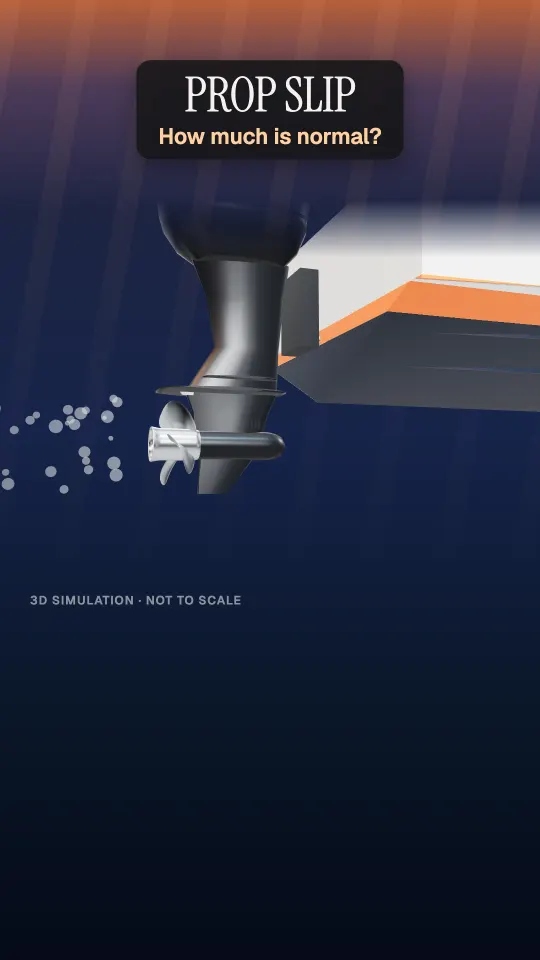
- The prop draws air (ventilation). The engine revs up, but the boat doesn’t speed up. It often happens in turns, or with the engine trimmed far out. Trim in, and have a shop check the engine height and the plate above the prop. This applies to outboards and sterndrives.
- The insert in the hub has lost its grip (spun hub). Outboard and sterndrive props have a rubber or plastic insert in the hub. When it wears, the shaft can turn inside the prop. Draw a straight line from the end of the prop shaft onto the prop’s hub. Run at full throttle for a while. If the two parts of the line no longer meet, the insert has lost its grip.
- The blades are damaged, or the prop cavitates. A bent, chipped or worn blade gets a poorer hold on the water. Small pits in the blades are a sign of cavitation: the water boils on the blades, and the prop loses its grip. Have a prop shop repair the prop and measure its pitch.
- The hull is fouled, or the boat is heavily loaded. Growth on the hull and prop, or a full load, costs speed at the same rpm. Clean the hull and prop, and measure again at a normal load.
- The prop is too small for the boat. A prop with too little diameter or blade area slips more. Then the prop size is the problem: the free check works out whether your prop suits your boat and engine.
What does low slip mean?
Slip well below normal usually means one of your figures is off. Did you run both ways? A current or a tail wind raises the speed over ground. Check the tachometer against a handheld one, and check the gear ratio in the manual. Check the pitch too: after a repair or a re-pitch, it may no longer match the number on the hub. A cupped prop, one with the trailing edge of its blades bent slightly, gets a better hold on the water, so it slips less. Slip below zero means a figure is wrong, or a current or the wind helped.
Pro shows the slip before the new prop goes on
A prop shop with Pro can compare the slip of the present prop with the slip of the new one. It sees both at full throttle and at every rpm in the running table. How we test our calculations.
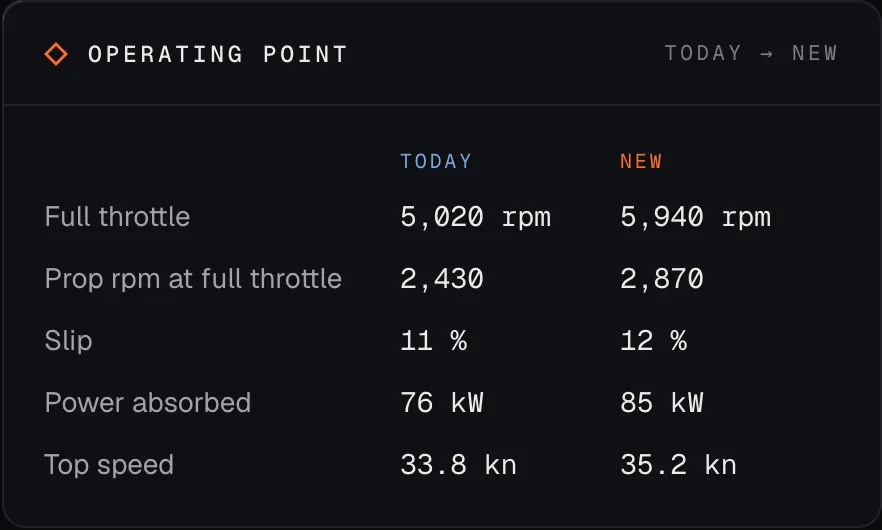
The picture is Pro’s calculation for an 18 ft (5.5 m) boat with a 115 hp outboard. With its present 14 × 19 in prop, the engine reaches only 5,020 rpm. With the new 13 × 17 in prop, the engine reaches 5,940 rpm and the boat goes 1.4 knots faster. The new prop does slip a little more: less slip isn’t the goal in itself.
How we worked it out
We worked out the full-throttle slip of every sea trial with all four figures: engine rpm, gear ratio, pitch and measured speed. Where the source doesn’t give the gear ratio, the trial is left out. Sea trials with slip below zero come in only once we have checked their figures in the source. The figures are medians, and the range shows the slip of the middle half of the trials. We work the figures out again whenever we add sea trials.
We use the measured speed, which gives what is called apparent slip. The water just behind the hull moves with the boat, so the prop’s real slip is higher than the apparent slip.
Sources: Wärtsilä’s encyclopedia on slip, pitch and the wake fraction, and an article on boattest.com on what makes a prop slip. You’ll find most of the sea trials, with their sources, on our boat pages and engine pages.
Read next: Is your prop too big or too small?
All guides →