Folding or fixed prop on a sailboat?
By Propbench · updated 5 November 2026Choose a folding prop if you sail a lot. On a 32 ft boat, a fixed prop costs about 0.2 knots under sail and a folding prop almost nothing. Under engine the two are just as fast. The folding prop is the weakest astern, so if you want strong reverse and short stops in the marina, choose a feathering prop.
What does a fixed prop cost under sail?
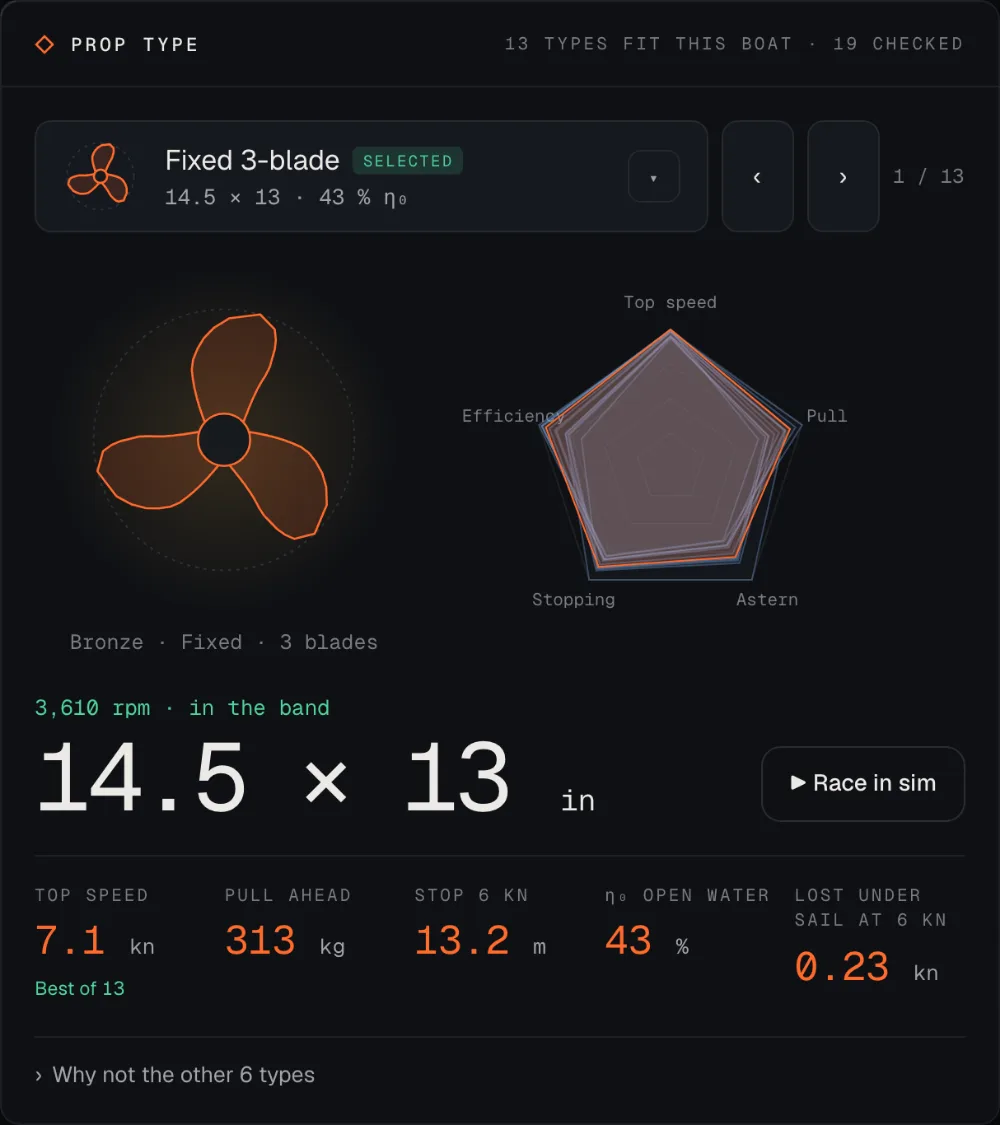
Our 32 ft (9.8 m) example boat has a 30 hp saildrive. At 6 knots under sail, a fixed three-blade prop locked in gear slows it by 0.23 knots. That is almost 4 %. A folding or feathering prop costs less than 0.01 knots, because the blades fold shut or turn edge-on to the flow.
On a 30 nautical mile passage, the fixed prop adds about 12 minutes. On a 36 ft (11 m) boat with 40 hp on a shaft, the loss is almost the same: 0.25 knots.
Under engine, the difference is small
Sized right, the fixed and the folding prop are equally fast on the smaller boat, at just over 7 knots. On this boat the folding prop even pulls a little harder ahead: 328 kg against 313 kg. On the 36 ft boat the folding prop pulls 436 kg ahead and the fixed prop 442 kg. The feathering prop is about 0.3 knots slower on both boats, but it pulls almost as well: 302 kg on the smaller one.
The feathering prop is the best astern and stops the soonest
In reverse the gap is large. The feathering prop pulls 259 kg astern, the fixed prop 207 kg and the folding prop 170 kg. Go full astern from 6 knots, and the feathering prop stops the boat in 11.7 m. The fixed prop needs 13.2 m and the folding prop 14.7 m. The feathering prop stops the boat 3 m sooner than the folding prop, about a third of the boat's length. On the bigger boat the order is the same.
Show the numbers
| Boat and prop | Top speed (kn) | Bollard pull ahead (kg) | Bollard pull astern (kg) | Stop from 6 kn, full astern (m) | Lost under sail at 6 kn (kn) |
|---|---|---|---|---|---|
| 32 ft, 30 hp saildrive · Fixed, 3 blades | 7.1 | 313 | 207 | 13.2 | 0.23 |
| 32 ft, 30 hp saildrive · Folding, 3 blades | 7.1 | 328 | 170 | 14.7 | 0.00 |
| 32 ft, 30 hp saildrive · Feathering, 3 blades | 6.7 | 302 | 259 | 11.7 | 0.00 |
| 36 ft, 40 hp shaft · Fixed, 3 blades | 7.0 | 442 | 292 | 14.2 | 0.25 |
| 36 ft, 40 hp shaft · Folding, 3 blades | 7.0 | 436 | 227 | 16.5 | 0.00 |
| 36 ft, 40 hp shaft · Feathering, 3 blades | 6.6 | 406 | 349 | 12.8 | 0.00 |
How to choose
- You sail more than you motor: choose a folding prop. It saves the 0.23 knots a fixed prop costs on the 32 ft boat, about 12 minutes on a 30 NM passage.
- You are often in tight marinas or reverse into your berth: choose a feathering prop. It pulls 259 kg astern against the folding prop's 170 kg and stops the boat 3 m sooner.
- You motor more than you sail, or want no moving parts: choose a fixed prop. It is as fast under engine as the folding prop and pulls harder astern, 207 kg against 170 kg. You pay with 0.23 knots every time you sail.
A prop shop can work this out for your boat
A prop shop with Pro can run this comparison for your exact boat. Pro checks 19 prop types and sizes each one that fits. Folding and feathering props from the big makers are included. On the 32 ft boat in this guide, 13 types fit.
How we worked it out
We worked out the figures with our calculation engine, on two of the example boats in Pro. Each prop is sized for its boat. Drag under sail and pull astern build on measured data: tow tests in the SVA tank in Potsdam and Yachting Monthly's prop test from May 2009. How we test our calculations
All guides →